
Voice Training Feedback: AI, Coach, or Real People?
AI analysis, voice coaches, and real human feedback each play a different role in voice training. Here's how to use all three effectively.
Written by: Charlie Murphy
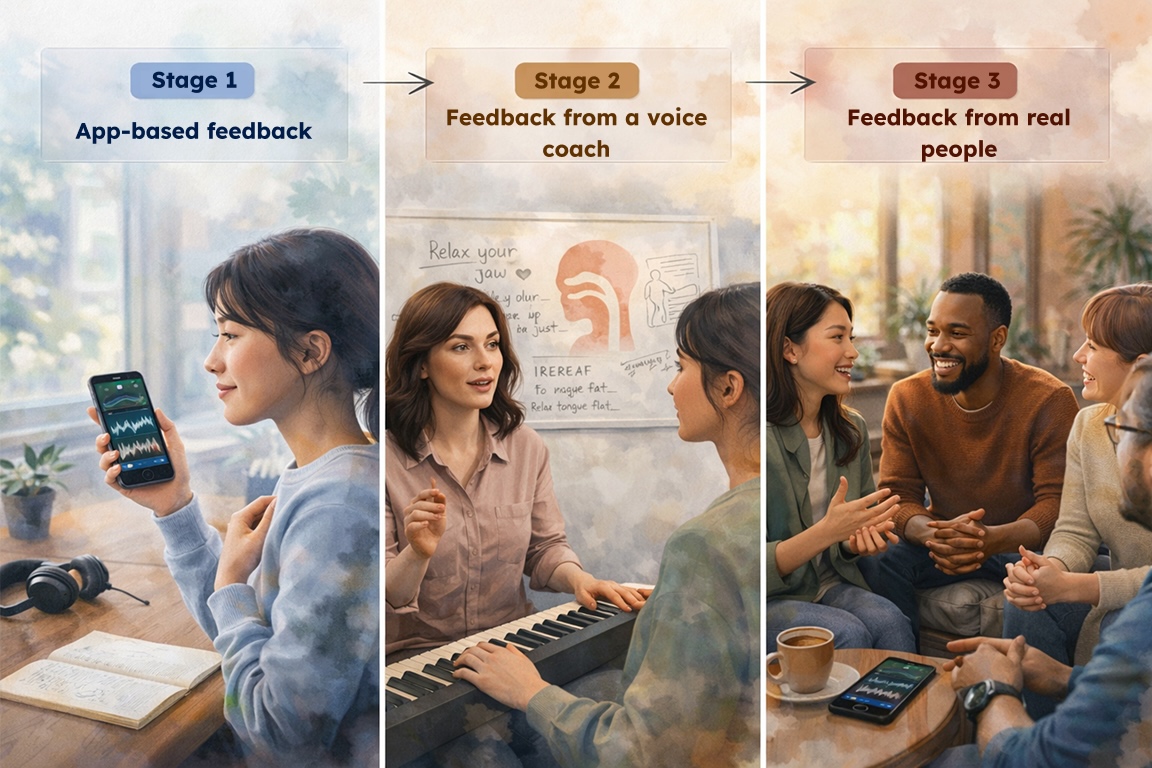
When you’re working on your voice, whether for singing, public speaking, acting, or just general vocal improvement, feedback is everything. But each source of feedback has its own strengths and limitations.
There are three distinct sources of feedback available to most voice learners today: apps that provide audio and AI analysis, professional voice coaches, and real people in your life. Each fills a different role, and understanding those differences can help you build a practice strategy that actually works.
Practicing Solo with Audio and AI Analysis
If you’re just starting out or want a low-pressure space to explore your voice, practicing solo with the help of an AI and audio analysis tool is a great first step.
The biggest advantage is that it’s judgment-free. There are no expectations, no social stakes, and nothing riding on any single recording. You can try something weird, make a mistake, and immediately listen back, without worrying about how another person perceives you. That kind of freedom is genuinely valuable, especially early in training when your voice sounds unfamiliar even to yourself.
Audio and AI analysis can measure objective acoustic features, such as: pitch, formants, volume, accent, gender, etc. These measurements give you a reliable baseline. You’re not guessing whether someone is just being overly nice or critical. You can see whether your pitch shifted or your formants moved in the direction you intended.
This is where apps like Strivocal come in. The app analyzes your recordings in real time, tracking pitch, formants, volume, and perceived gender so you can understand what’s happening acoustically and monitor your progress over time. Real-time feedback is especially helpful for learning new exercises and building awareness of how different vocal adjustments and muscle movements affect your sound.
That said, the end goal of any voice practice is to eventually use your voice with real people. Solo practice is a foundation, not a destination.
Strivocal provides real-time feedback on pitch, formants, volume, and perceived gender, so you can practice with confidence and measure your progress objectively.
Working with a Voice Coach
A voice coach and therapist aren’t just experienced listeners. They’re qualified professionals who bring knowledge that no app or friend group can substitute.
Good voice professionals understand the anatomy of the vocal tract and know how to guide you through exercises that target specific acoustic features without risking injury. Vocal strain and overuse injuries are real, and they’re more likely to happen when someone is pushing hard to make fast changes without proper guidance. A voice coach can spot early warning signs and help you develop habits that keep your voice healthy over the long term.
Beyond injury prevention, they bring structured methodology. They know which exercises build which skills, how to sequence them, and how to adjust when something isn’t working. They can hear nuances in your voice that neither you nor an algorithm will catch and translate those observations into specific, actionable feedback.
Strivocal is designed to work alongside a voice coach, not replace one. With the app, you can record sessions and share them directly with your coach between appointments. Your coach can review your recordings, listen to your progress, and give feedback informed by the acoustic data the app captures. It’s a way to make every session more productive and keep the work going in the time between meetings.
Getting Feedback from Real People
At some point, you have to take what you’ve practiced in private and bring it into the world. That changes things.
Sharing your voice with another person raises the stakes, and that’s actually a feature, not a bug. When someone else is listening, your brain engages differently. The motivation to communicate clearly, to sound the way you intend, sharpens. Practice in real social contexts builds vocal habits that transfer to everyday life in a way that solo drills simply can’t replicate.
Feedback from friends, family members, or a practice group also gives you something no algorithm can offer: a gut reaction. Real people tell you whether your voice reads as warm, confident, or natural. Those qualitative impressions matter a great deal but aren’t captured in a spectrogram.
Strivocal supports this directly. You can record your voice in the app and share clips with anyone: a close friend, a family member, an online voice training community, or a practice group. The recordings include your acoustic data, so the person you share with gets both the audio and the measurements, making it easy to have a structured, productive conversation about where you are and where you want to go.
Demo of the sharing feature in Strivocal, which allows you to share your recordings and acoustic data with friends, family, or a voice coach for feedback.
How Strivocal Supports All Three
Strivocal is built around the idea that voice training works best when you combine all three types of feedback:
- AI and audio analysis are built directly into the app. Every recording gives you real-time data on pitch, formants, volume, and perceived gender, so you can practice with confidence and measure your progress objectively.
- Sharing for human feedback is a core feature. Save your recordings and share them with a friend, family member, practice group, or anyone else whose perspective you value. Voice training is ultimately about communicating with other people, and the sharing feature reflects that.
- Voice coach integration is supported through the same sharing flow. Share your recordings and acoustic history with your coach so they can give you better-informed feedback and track your progress between sessions.
No single source of feedback tells the whole story. AI gives you objective data. Real people give you social reality. A voice coach gives you expertise and safety. Used together, they make a stronger foundation for lasting progress.
Want to try out Strivocal?
Strivocal is available on the web (iOS and Android are coming soon). You can try it for free at strivocal.com.